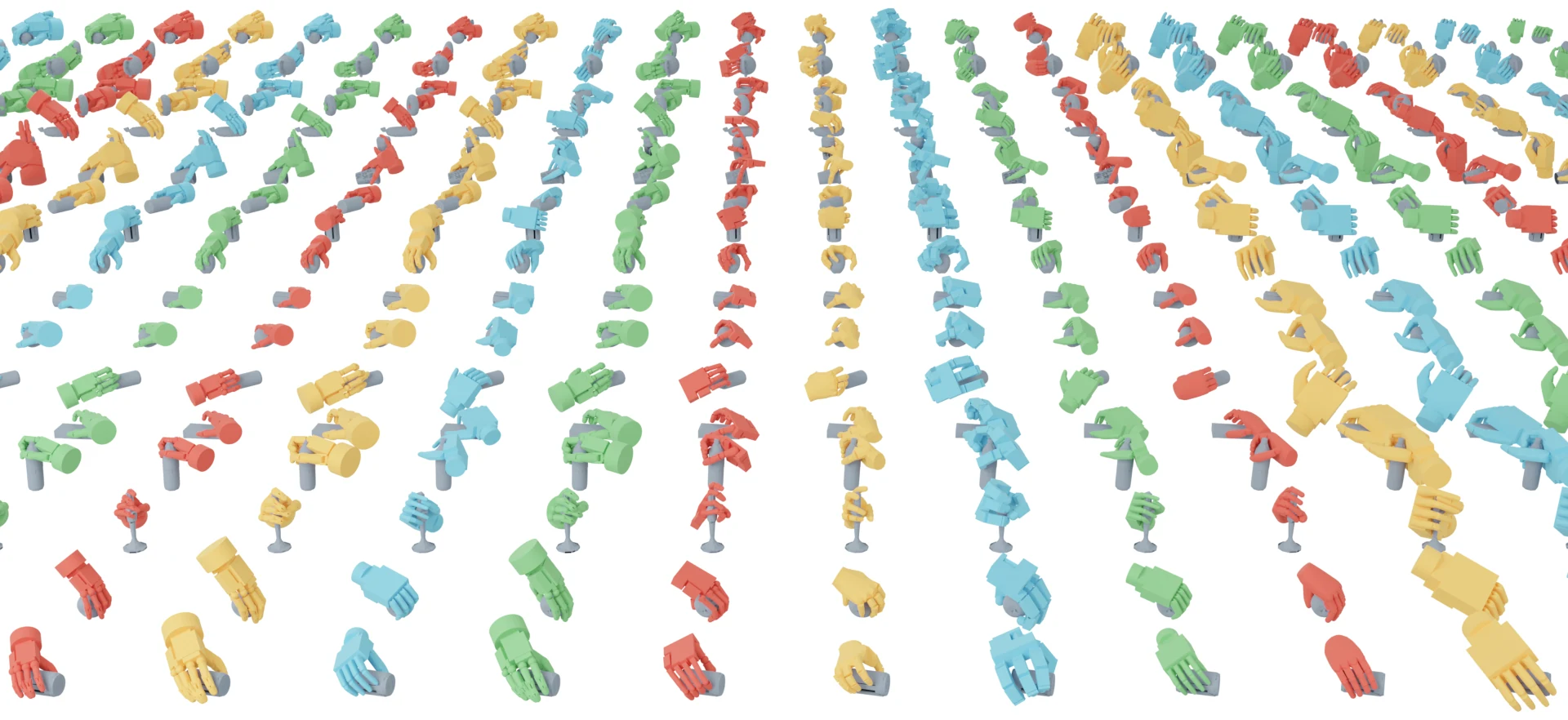
- 1,000
- robot & human hands
- 7k
- object scenes
- 200k
- source grasps
- 77.5%
- real-world success on an unseen hand
Abstract
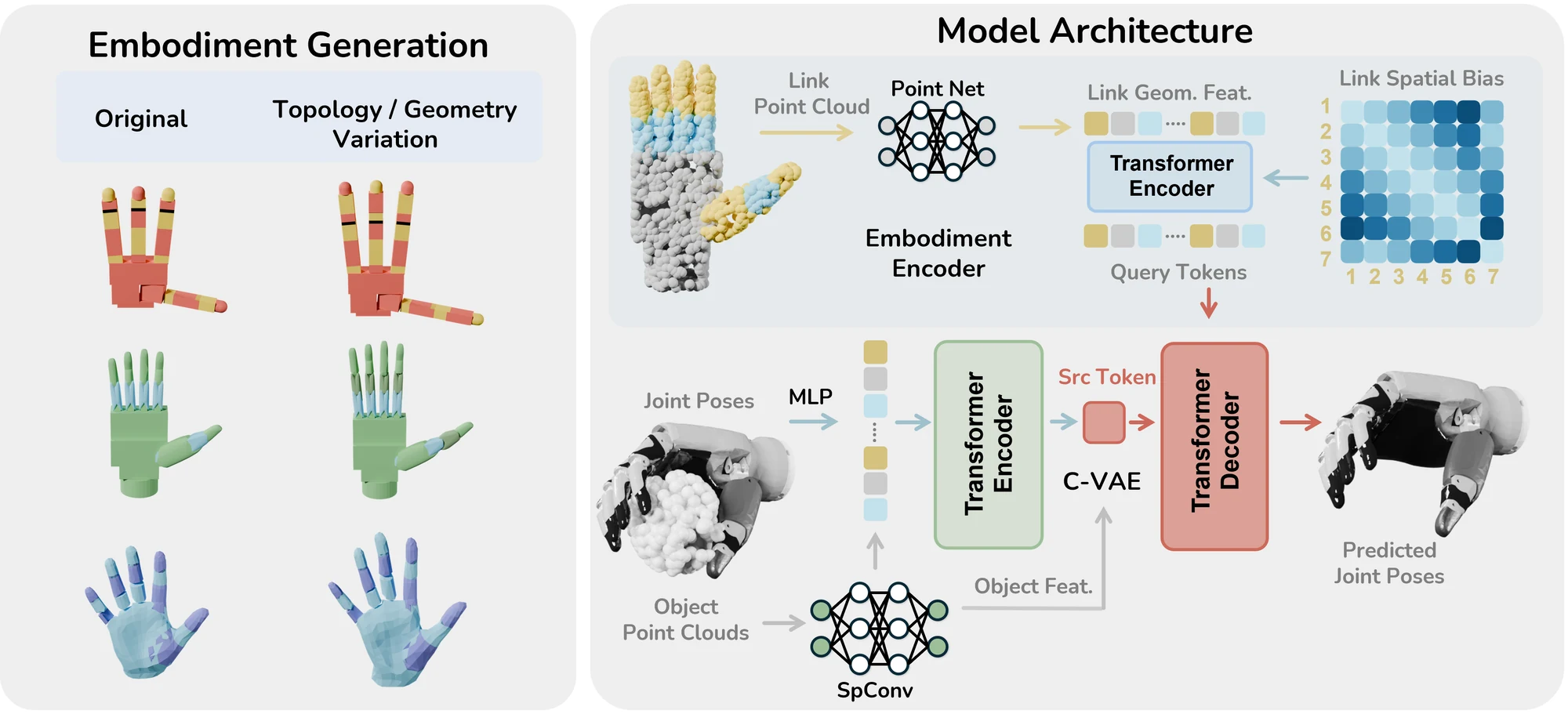
Generalizing dexterous grasping across diverse robot hands remains a fundamental challenge due to differences in geometry, topology, and kinematics. Inspired by recent advances in scaling up robot data, we show that scaling both the diversity and quantity of hand embodiments significantly improves generalization to unseen morphologies. We present XDex, a unified cross-embodiment grasp synthesis framework trained on the largest and most diverse multi-hand grasp dataset to date, spanning 1,000 heterogeneous robotic hands and 7k object scenes. XDex couples an embodiment encoder that jointly captures geometric and topological features with a three-way disentangled representation of object geometry, hand embodiment, and grasping pose. It outperforms prior methods in grasp quality and diversity and learning-based methods in cross-hand consistency, and generalizes to unseen hands in real-world settings.
Method
XDex separates a grasp into three factors, so a pose found on one hand can be decoded on another.
Self-improving data loop
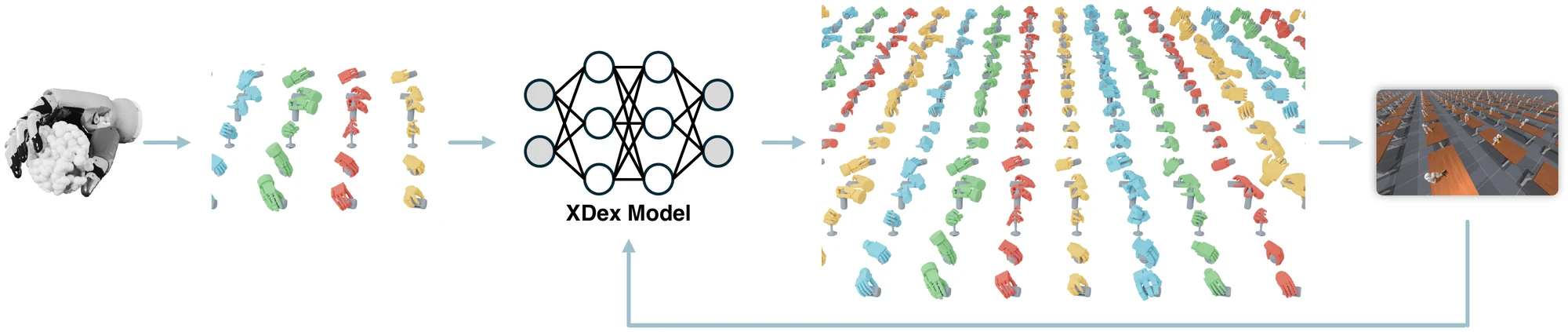
- Optimize 200k grasps for one source hand (Inspire) on 7k objects.
- Retarget to 6 sampled hands per object to form seed pairs.
- Train an initial XDex model on the seed set.
- Generate on all 1,000 hands, filter by IK and simulation, then retrain.
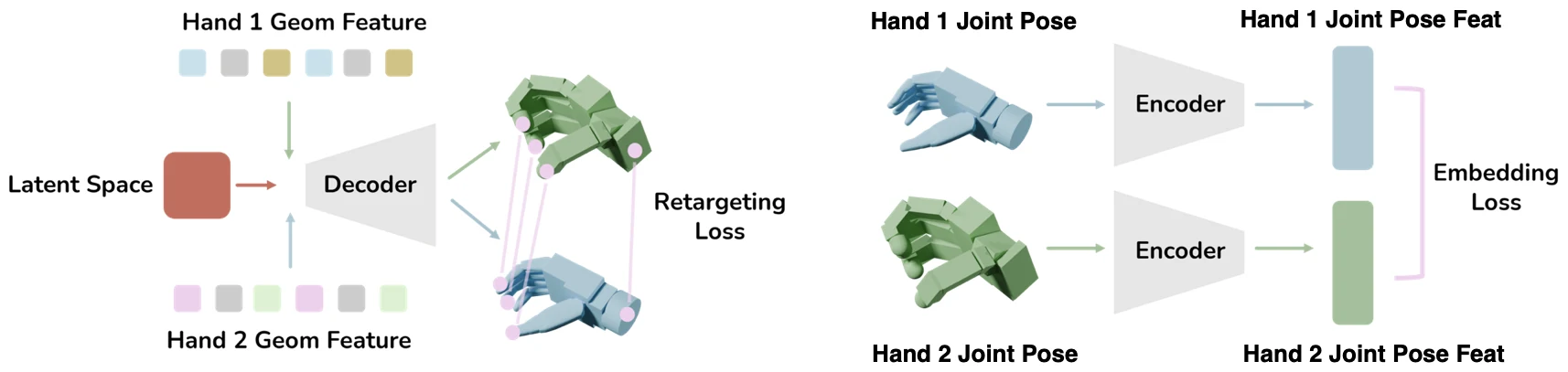
Consistency losses
Grasp Synthesis Results
Evaluated on 500 held-out scenes in ManiSkill. Ability and Schunk are the unseen hands.
| Quality | Consistency | Diversity | ||||
|---|---|---|---|---|---|---|
| Method | SR ↑ | Pen (cm) ↓ | Pos Diff (cm) ↓ | Vec Diff (cm) ↓ | H mean (bits) ↑ | H std (bits) ↓ |
Bold marks the best value in each column. Retargeting has the lowest position differences because it directly minimizes keypoint discrepancy, without accounting for object-aware grasp quality. D(R,O)* is retrained on our tabletop data, and its seen-hand metrics average over Shadow and Allegro, the seen hands its pre-trained encoder covers.
Disentangled grasp poses
Each row uses the same object point and latent z, decoded on different hands, and the grasps stay consistent. Each column varies z on one hand, and the poses stay diverse.
Generalizing to new morphologies
Each pair decodes the same grasp on an original hand (left) and a modified one (right): a fingertip removed, an extra distal link, a scaled link or whole hand, or a locked joint.
Embodiment Scaling Law
Scaling hands vs. scaling data
More data alone does not buy generalization. Diversity of hands does.


Real-World Deployment
We deploy XDex on an xArm from a single calibrated third-person camera. It samples 128 candidate grasps from a partial point cloud, keeps the first one that passes arm IK and table-collision checks, and executes it open-loop.
Unseen hand, unseen objects
The Ability Hand was held out of training entirely.
Changing the hand's topology
XDex also handles XHand configurations with three and two fingers.
3-finger XHand
2-finger XHand
Application: Object-Aware Neural Retargeting
XDex can translate one grasp into another: it encodes a human (MANO) hand pose and decodes a robot hand pose, conditioned on the object and on the robot hand's geometry.
In simulation
Kinematic retargeting copies the human pose without regard to the object. Neural retargeting keeps the posture and still grasps it.
On a real robot
A human hand and a robot hand each grasp one of two identical bottles. During reaching, both setups use standard teleoperation. At contact, the human keypoints go through XDex.
Without neural retargeting
Keypoint-only retargeting ignores object geometry, so the task fails.
With neural retargeting
XDex preserves the human's posture and still produces a feasible grasp.
BibTeX
@inproceedings{wang2026xdex,
  title     = {XDex: Learning Cross-Embodiment Dexterous Grasping with 1000 Hands},
  author    = {Wang, Keyi and Ye, Jianglong and Yuan, Chengjing and Wang, Xiaolong},
  booktitle = {Conference on Robot Learning (CoRL)},
  year      = {2026}
}
This work was supported, in part, by NSF CAREER Award IIS-2240014 and NSF CCF-2112665 (TILOS).